
Oregon Rural Schools: Viability, Thresholds, and the Doom Loop.
A longitudinal analysis of enrollment decline, student outcomes, and expenditure dynamics across 207 Oregon school districts, 2015–2023.
Rural Oregon school districts are outperforming their urban peers on three of five student outcome measures — for now. Beneath that headline result, 46 percent of Oregon's school districts are simultaneously losing enrollment, experiencing deteriorating outcomes, and absorbing rising per-pupil costs driven by fixed expenses spread across a smaller student base. This is the three-condition signature of an active doom loop — not a future risk, but a present condition.
Three Hypotheses. Three Verdicts.
High-risk rural districts are not lagging — they are punching above their weight. Tier 1 (most fragile) districts outperform Tier 3 (metro) on attendance, Grade 3 ELA, and Grade 8 Math.
The spending-outcomes relationship is real but narrow, concentrated in rural districts at high expenditure levels. Oregon's high rural PPE is a cost-spreading artifact — and the state distributes 23% less to high-poverty districts than to low-poverty ones, the largest gap in the nation.
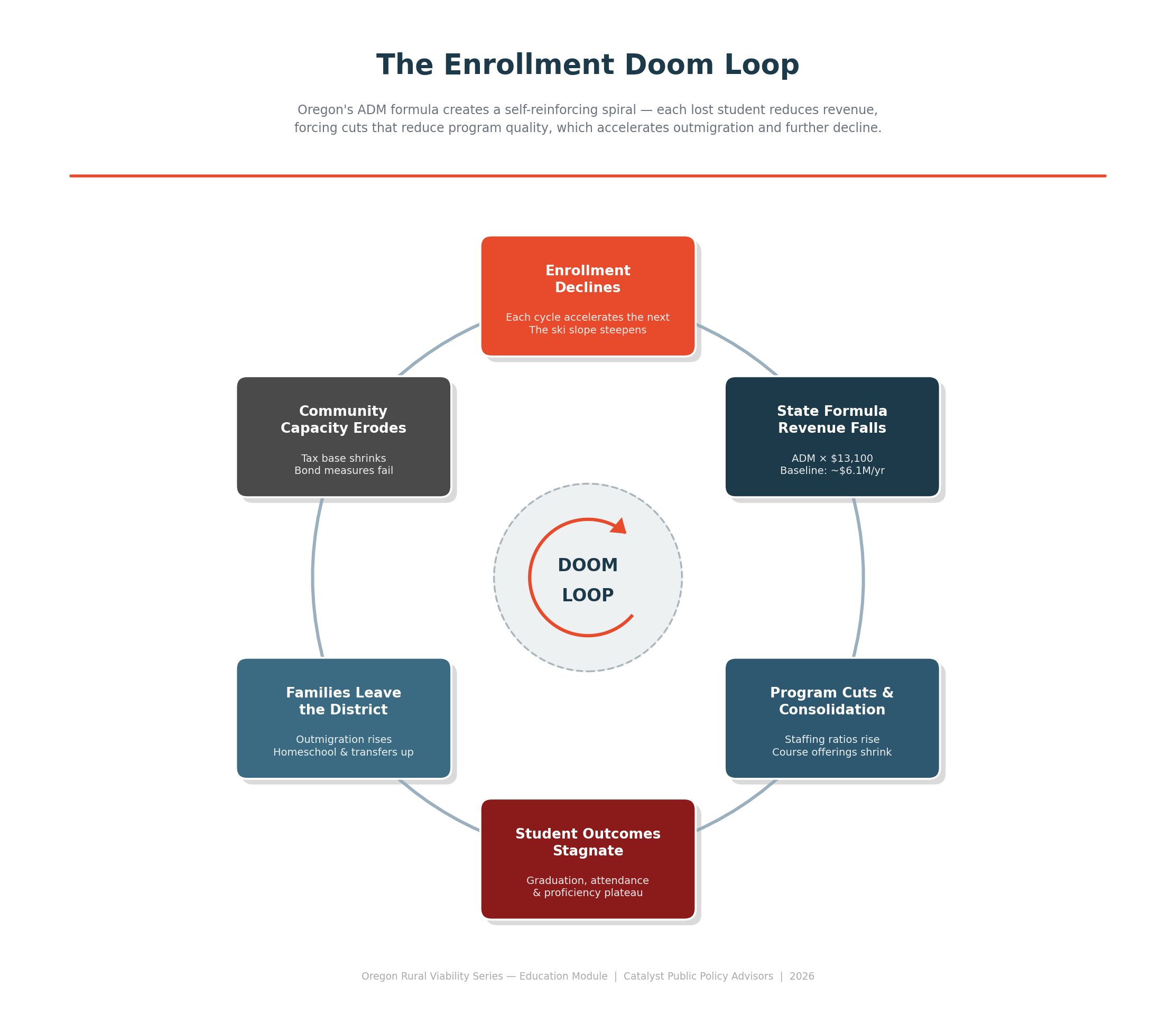
82 of 180 districts (46%) are in an active doom loop: enrollment decline drives outcome deterioration, which feeds further decline. A non-linear threshold near 200 ADM marks where the ski slope begins to steepen.
The Threshold Problem
Rural districts are currently outperforming because they haven't fully crossed the institutional viability threshold — yet. The analysis confirms a non-linear inflection point near 200 average daily membership (ADM): graduation outcomes accelerate in their deterioration for districts below this floor, and each additional point of enrollment loss causes disproportionately greater harm.
This is the ski slope: above the threshold, the community absorbs stress and recovers. Below it, the same rate of decline produces disproportionately greater harm. Intervention before the inflection point is dramatically more cost-effective than after.
The Policy Implication
Coordinated, place-based investment that maintains communities above their institutional viability thresholds is more effective than single-sector intervention. Schools cannot retain families if there are no jobs. Jobs cannot attract workers without housing. Housing markets fail without health care. The sectors reinforce each other in both directions — the education data documents the leading edge of a systemic process that will appear, in sequence, in health care, housing, and employment analyses to follow.